5 Ways Spoken Word Poetry Is a Game Changer in the Classroom
By Shawntee` Herring – Director of bluapple Poetry Programming, Jason Taylor Foundation
Spoken word poetry is often described as a calling, and for me, that’s exactly what it was. I didn’t set out to become a poet; in fact, I never thought poetry would be a part of my life’s work. I was that kid who kept a diary, then a daily journal, and always had a pen in my hand. I loved words, but poetry? That was just something I doodled in notebooks or studied in class—until spoken word came along and flipped the script.
My first experience with spoken word was in 2000, at a college open mic. I remember sitting there, completely captivated by the rhythm and the way the poet on stage commanded language. The raw power in her words unlocked something in me. I was hooked.
It wasn’t just about writing anymore; it was about owning my voice and telling my story. That’s when everything clicked. Spoken word became my passion, my calling, and eventually the foundation of my career.
Now, with 20 years of teaching experience and a few Gold Keys from the Scholastic Art & Writing Awards under my belt, I’ve seen firsthand how spoken word can transform classrooms. My journey into poetry didn’t start with some grand plan; it started with a teacher who saw something in me and pushed me to find my voice.
What began as a student-to-poet-to-teacher journey has turned into a mission: to empower others through the art of spoken word. Here’s how this art form can completely change the educational game:
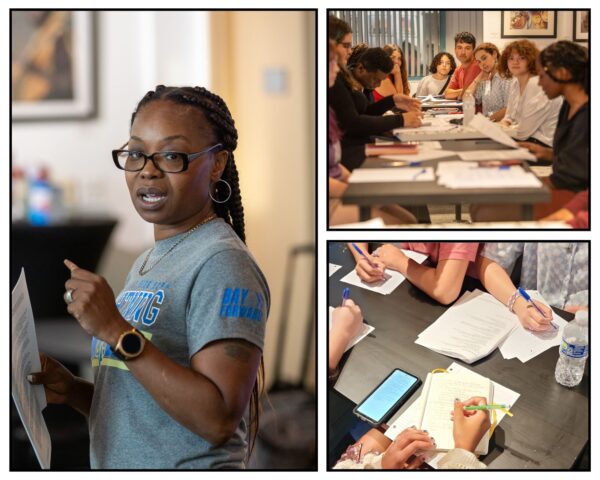 1. It’s the Ultimate Language Bootcamp
Spoken word poetry is like a personal trainer for your communication skills. It forces you to flex those verbal muscles and master the art of powerful, effective expression. As students write and perform, they learn how to articulate their thoughts with laser-like precision and confidence. These are invaluable skills, not just in school, but in life, whether a student is giving a presentation, having a difficult conversation, or just trying to convince someone that yes, they did read the assigned novel.
2. It’s a Passport to Self-Discovery (and Confidence)
Spoken word poetry doesn’t just ask students to write; it’s a journey of self-exploration, where students dive into their identities and experiences. And the best part? It pushes them to find their own voice. The results are stunning: a boost in confidence and a newfound understanding of themselves and the world. Who knew self-reflection could be this empowering?
3. It Gives Students the Power to Rewrite Their Story
Spoken word is a form of literary alchemy: students take their experiences, whether challenging or victorious, and transform them into powerful narratives. By reclaiming their stories, they not only find healing but also gain control over their own narrative. That sense of agency is like a superpower that fuels empowerment and growth. They’re not just telling stories, they’re rewriting their own destinies.
4. It’s the Ultimate Listening and Empathy Exercise
Spoken word poetry is not a monologue; it’s a conversation. It’s a culture of listening, where students are encouraged to tune in to the diverse voices and experiences around them. This kind of deep listening fosters empathy, promotes understanding, and helps students (and audiences) to connect on a human level. By sharing poetry, students realize the power of hearing one another, creating a classroom community that’s grounded in mutual respect.
5. It Reminds Students That Every Voice Matters (Especially Their Own)
If there’s one thing that spoken word reinforces, it’s this: your voice matters. In a world where it’s easy to feel overlooked, poetry acts as a megaphone, amplifying each student’s story. When students perform their work, it’s a declaration: “I am here. I am important. My voice deserves to be heard.” This validation boosts self-esteem and encourages students to continue sharing their voices, both in the classroom and beyond.
Having been lucky enough to earn recognition as an educator of poetry through the Scholastic Art & Writing Awards, I have come to understand the importance of validation. As the Program Director of the Omari Hardwick bluapple Poetry Network, I’m passionate about helping students find and amplify their voices. I believe spoken word can open doors and empower the next generation of thinkers, creators, and activists.
If you’re an educator eager to bring spoken word into your classroom (trust me, you should), I invite you to connect with the Omari Hardwick bluapple Poetry Network. We have resources, curriculum, professional development, and the kind of teaching artist support that’ll make your classroom feel like a creative powerhouse. Let’s create a space where every student’s voice is celebrated, valued, and heard
If you’re a poet or an educator who would like to start a poetry club on your campus, you can contact the Jason Taylor Foundation for access to the Omari Hardwick bluapple Poetry Network where a variety of programs and services are available, including a free poetry curriculum, professional development, teaching artist support, conferences, workshops and festivals, as well as the opportunity to connect with students and educators across South Florida who share your passion in this important and necessary art form. Please email us at info@jasontaylorfoundation.com, call us at 954.424.0799, or follow us @jtfoundation99 or @bluapplepoetry.